Compare Hugo Bee, Mounjaro, and Saxenda yo-yo! Acro Oriental Clinic
Acro Oriental Clinic2026.06.015,174 views
Key summary
Saxenda, Hugo Bee, and Mounzaro are popular drugs these days! Losing weight is also losing weight, but aren't you wondering which Yoyo would work best?
A large-scale meta-analysis published at BMJ in January 2026 provided the clearest answer to this question. Here's the bottom line.
• Short-term winners at 1 year: Mounjaro > Hugo Bee > Saxenda — Mounjaro's weight loss was deep, so even with strong yoyo, he still lost the most weight.
• Reversal after 1.5 to 2 years: Saxenda > Hugo Bee = Mounjaro — The faster the medicine regrowth, the sooner Yoyo comes.
• 3.9-year long-term winner: behavioral therapy — Medications all reach baseline within 1.5 to 1.7 years, but behavioral therapy slowly returns over 3.9 years.
Today's data after discontinuation of the three drugs As the paper figures are Organize, and on top of that, organize realistic strategies to reduce yoyo.

Q1. If I quit Hugo Bee, Mounjaro, and Saxenda, why do they all start again?
Yo-yo after stopping all three drugs is a common pattern. According to a meta-analysis (West et al., BMJ 2026; 9,341 people, 37 studies) published in BMJ by an Oxford research team in 2026, when a new GLP-1 drug (semaglutide and tyrzepatide) is stopped, weight rises again at an average rate of 0.8 kg/month and returns to the original weight after about 1.5 years (18 months). In the same analysis, it was reported that if you lose weight and stop using behavioral therapy, it takes about 3.9 years to return to the original weight. In other words, drug yo-yo is more than twice as fast as behavioral therapy yo-yo.
The mechanism is simple. GLP-1 suppresses appetite by creating a feeling of fullness and slowing gastric emptying. When you stop taking the medicine, this' break 'goes away and your appetite returns. The more weak the person, the greater the impact of interruption.
Q2. What kind of medicine is Saxenda (liraglutide), and what happens if I stop taking it?
Saxenda was the first GLP-1 obesity treatment approved by the FDA in 2014. The clinical trial (SCALE Obesity and Prediabetes, Pi-Sunyer et al., NEJM 2015; n=3,731) showed an average loss of 8.0% over 56 weeks, and weight and fasting blood sugar partially rebounded in the 12-week suspended substudy.
What's interesting is the actual medical data. According to Epic Research's Cosmos database analysis (2024; based on electronic health records, 17,733 liraglutide users), 18.7% fully returned to or gained more than their original weight after discontinuation, but 55.7% succeeded in maintaining or losing additional weight at the time of discontinuation. Rather than being a medicine with a low rate, Saxenda is close to a structure where the absolute amount of yogurt appears small because the reduction range itself is small.
Q3. WegoB (semaglutide) is said to have a significant reduction in weight, but what happens if I stop it?
WeGoB is a 2021 FDA-approved 2.4 mg injection of semaglutide.
The basic data was an extended STEP 1 analysis (Wilding et al., Diabetes Obes Metab 2022; 24:1553-64; n=327), which recorded the largest non-paralysis reduction value at the time, with an average loss of -17.3% when taking 68 weeks.
The problem was after that. About 2/3 of the dose loss (average +11.6 percentage points) came back within 1 year after stopping the medication, and the final net loss was only -5.6%. Cardiovascular and metabolic indicators (blood pressure, blood sugar, lipids) also returned to the baseline direction. A follow-up estimate (West et al., BMJ 2026) also came out that this recovery rate will be completed within approximately 1.4 years.

Q4. Does Maunjaro (tyrzepatide) have the worst yoyo?
“Is yoyo the worst?” At what point do you watchDepending on, the answer is completely different.
The point is that the ranking of the three drugs changes over time.
First, basic data from Mounzaro
Maunjaro (ingredient name tyrzepatide) is a GIP/GLP-1 dual agonist. In the SURMOUNT-4 study (Aronne et al., JAMA 2024; 331 (1) :38-48), 670 adults with an average body weight of 107.3 kg averaged 36 weeks of open-label use 22.4 kg (-20.9%) weight lossIt has reached After that, as a result of tracking 52 weeks by randomly assigning the Yuji group (drug duration) and the discontinuation group (placebo conversion) at 1:1, the maintenance group lost an additional -5.5%, reaching a total of -25.3%, while the discontinued group averaged about weak I gained 14 kg (+14%) of weight again (Based on treatment-regimen estimand, which is the primary analysis of the paper. The treatment estimand analysis reported maintenance group -6.7% and discontinuation group +14.8%). A post-mortem analysis (Horn et al., JAMA Intern Med 2025) also revealed that 82% of the discontinued group regained 25% or more of the weight lost.
Short-term winners at 1 year: Mounjaro > Hugo Bee > Saxenda
Looking at it from a 1-year Because the re-increase is the largest, but the initial loss is deep The absolute remaining loss is around 12 to 13 kg, which is the largest of the three drugs(Wigobi approx. 8 kg; Saxenda approx. 3-4 kg). The short-term winner is clearly Mounzaro.
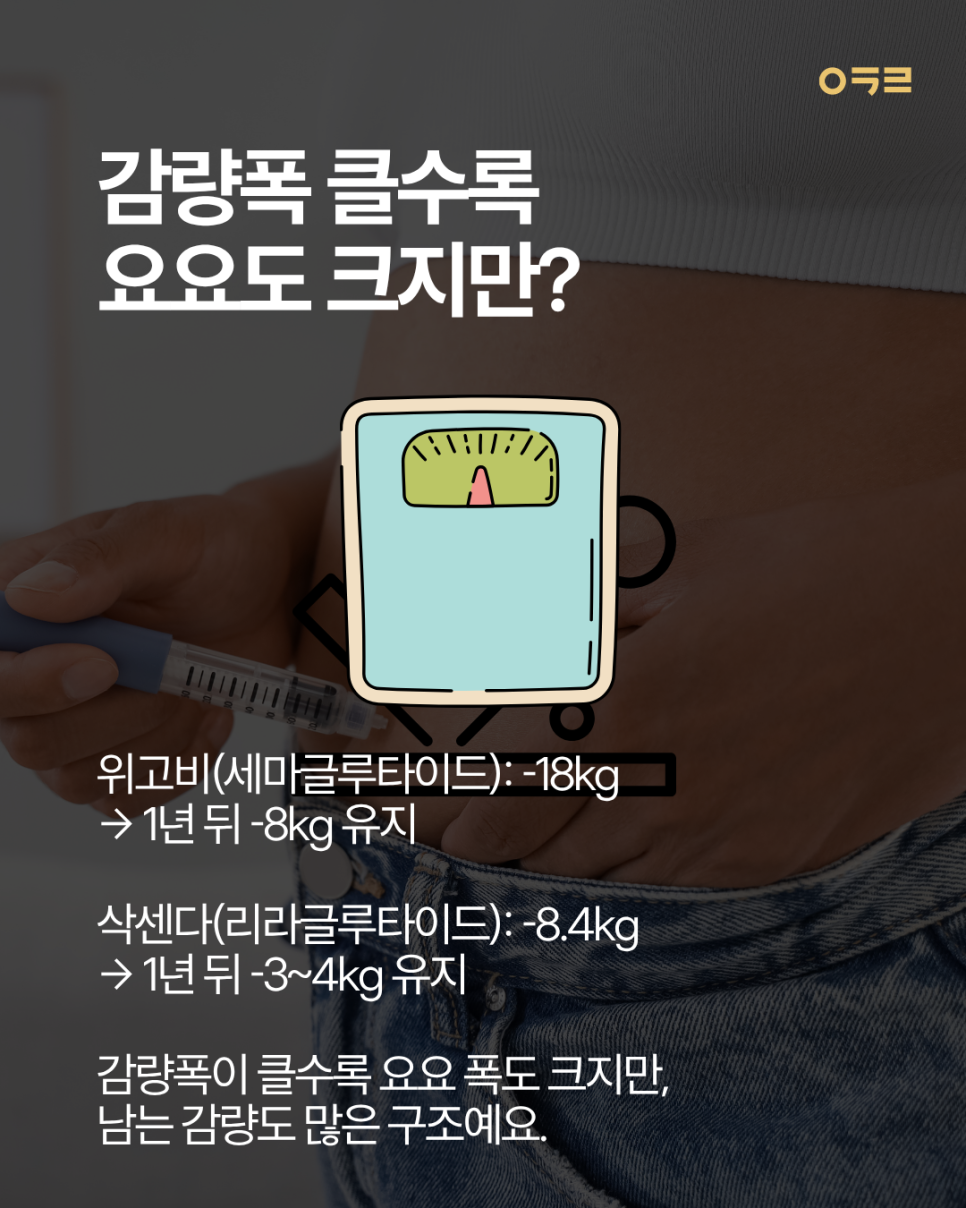
Ranking reversal between 1.5 and 2 years: Saxenda > Hugo Bee > Mounjaro
By the way If you look at it from a 1.5-2 year perspective, the picture is reversed. According to the BMJ 2026 meta-analysis (West et al.), the rate of regrowth varies between drugs. The new GLP-1 (semaglutide, tyrzepatide) 0.8 kg per month, What is the overall drug average 0.4 kg per monthThis is it. In other words, the deeper the dose reduction range, the faster the rate of re-growth.
This difference in speed erodes the advantage of initial reduction over time. Assuming a starting body weight of 100 kg:
• Mounjaro(0.8 kg re-increase per month, starting -22.4 kg): Reached the baseline in about 1.5 years, then increased
• Wegobi(0.8 kg re-increase per month, starting -18 kg): Reached the baseline in about 1.5 years, then increased
• Saxenda(estimated re-increase of 0.4 kg per month, starting at -8.4 kg): The baseline was reached in about 1.7 to 2 years
Consequently Around 2 years ago, Mounjaro and Wigobi became fatter than their original weight, while Saxenda is still near the baseline. The ranking at this point is based on remaining weight loss Saxenda > Hugo BeeIt is reversed to It is a structure where the “side that steamed quickly” encroaches on the advantage of the “side that removed deeply.”

3.9-year long-term winner: behavioral therapy
If you stop after subtracting it from the same BMJ analysis as behavioral therapy, you will return to a very slow rate of 0.1 kg per month It wasn't until 3.9 years that the baseline was reachedYes, there is the least amount of loss left at 1 year, but it is not reversed by any medication in the long run.

4 important limitations
• The BMJ meta-analysis specified that the measured data over 12 months is limited. The trajectory after 1.5 years is predictive data for the BMJ meta-analysis.
• BMJ did not report Saxenda individually, and 0.4 kg per month is an estimate of the 'overall drug average' applied to Saxenda.
• Although Mounjaro and Hugo Bee were assigned the same rate (0.8 kg/month) by BMJ as the “new GLP-1,” there is a possibility that Mounjaro will return faster than Hugo when considering SURMOUNT-4 measurements (52 weeks +14%).
• eClinicalMedicine 2026 nonlinear analysis (Budini et al.) reported that yoyo slowed after 52 weeks and stagnated at around 75% of weight loss. The actual trajectory may be gentler than linear.
The individual curve varies greatly depending on the discontinuation method (rapid discontinuation vs. low dose reduction) and whether changes in behavior occur during use. This is why Q7's “4 ways to prevent yo-yo” is critically important.
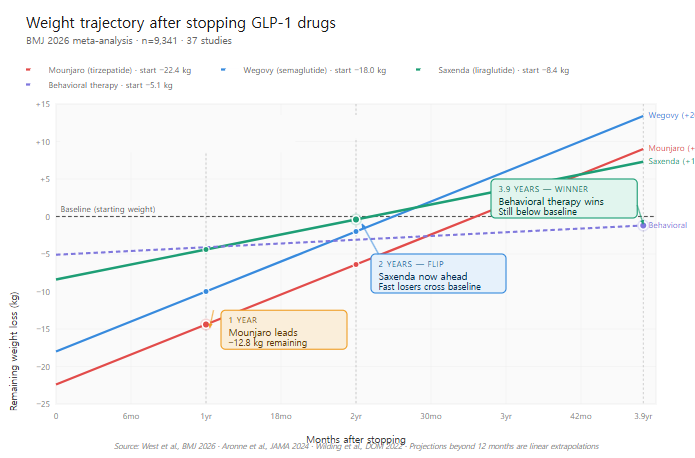
The above graph summarizes this content at a glance. If you draw the weight trajectory of the four methods for up to 48 months, it looks like this.
If you look at the graph, you can see that Mounjaro (red) maintains the deepest loss at 1 year, but breaks through the baseline around 1.5 years.
Behavioral therapy (purple dotted line), on the other hand, stays below the baseline for 4 years.
Q5. How can the three medications be compared to behavioral therapy?
The table below shows the data when the three drugs were completely discontinued. The comparison group was “people who stopped the program after losing weight only through diet or exercise without medication.” The unit is unified in kgand% are listed in parentheses.
itemSaxenda (liraglutide)WegoB (semaglutide)Mounjaro (tyrzepatide)Control group: Discontinuation of behavioral therapy
Representative researchSCALE (NEJM 2015)STEP 1 ext (2022)SURMOUNT-4 (JAMA 2024)BMJ 2026 Behavioral Therapy Integrated Data
Treatment period56 weeks68 weeks36 weeks12 to 52 weeks
Reference weightabout 106 kgabout 105 kgabout 107 kgVaries from study to study
Average loss during treatment-8.4 kg (-8.0%)-18.0 kg (-17.3%)-22.4 kg (-20.9%)-5.1 kg (about -5 to 6%)
Yoyo speed after interruption (BMJ 2026)0.4 kg/month0.8 kg/month0.8 kg/month0.1 kg/month
Re-increase after 1 year≈ 4~5 kg≈ 9~10 kg14 kg (measured at 52 weeks)≈ 1.2 kg
Remaining weight loss after 1 year (short-term winner)≈ -3~4 kg≈ -8 kg≈ -12~13 kg≈ -3.9 kg
Estimated time to return to original weightabout 1.7 yearsabout 1.5 yearsabout 1.5 yearsabout 3.9 years
2-year forecast (reversal)0 kg (near baseline)≈ +1 to 2 kg (already increased)≈ +1 to 2 kg (already increased)Still maintaining a weight loss of at least -3 kg
3.9 year long term winnerExpected gain of +5 to 8 kgExpected gain of +5 to 8 kgExpected gain of +5 to 8 kgBaseline reached (winner)
Note: The figures after 1 year are a combination of direct measurements from the original paper (STEP 1 ext, 52 weeks SURMOUNT-4) and BMJ 2026's monthly rate estimates. Saxenda's individual monthly rate was not reported separately by the BMJ and is estimated based on the overall drug average (0.4 kg/month). Although the same speed (0.8 kg/month) was assigned the same speed (0.8 kg/month) by BMJ as the “new GLP-1”, SURMOUNT-4 measurements were greater than this. 1.5 years later, the BMJ forecast.
Key messages: At 1 yearIn Maunjaro > Hugo Bee > Behavioral Therapy > Saxenda Drugs take the lead in order. At 2 yearsWhen this happens Saxenda > Hugo BeeRankings between drugs are reversed, and drug groups reach or surpass the baseline. 3.9 yearsIn, only behavioral therapy adheres to the baseline and becomes a long-term winner. Short-term winners and long-term winners are completely different structures.

Q6. Why is yoyo different from those who take it out of medicine and those who take it out of exercise?
The most obvious finding in the BMJ meta-analysis (West et al. 2026, n=9,341) is the difference in time it takes to return to the original weight.
Here's how the data is organized.
• If you lose weight with behavioral therapy alone and then stop the program → return to your original weight over about 3.9 years
• Overall drug average → return to original weight after about 1.7 years
• New GLP-1 (Hugo Bee, Mounjaro) → Return to original weight after about 1.5 years (about 18 months)
In other words, drug yo-yo is about twice as fast as behavioral therapy yo-yo.
According to the monthly rate in the same BMJ analysis, the group that stopped behavioral therapy was about 0.1 kg/month, the entire drug was about 0.4 kg/month, and the new GLP-1 was about 0.8 kg/month, which is 4 to 8 times that of behavioral therapy. Also, this difference is independent of the initial weight loss. Whether you lose 5 kg or 10 kg, the recovery rate when taking medicine is faster than when subtracting it with behavioral therapy.
The conclusion of the same analysis is that metabolic indicators (blood sugar, blood pressure, cholesterol, triglycerides) also return to their original state within about 1.4 years after discontinuation of the drug.
The reason is simple. For people who have lost weight with behavioral therapy, the subtraction process itself is a habit.
As long as you don't completely let go of that habit, your weight will slowly return. On the other hand, for people who only take medication, “quitting” is removing the only brake. If new eating and exercise habits are built while the medicine suppresses appetite, this gap will be filled to some extent, but if not, you will still receive an appetite rebound. However, it is important to remember that behavioral therapy initially has a small weight loss range (about 5 kg on average).
Meanwhile, actual medical data points in the same direction.
Real world observations introduced by Cleveland Clinic's Gasoyan et al. (AJMC 2026) reported that actual patients' yawning was less rapid than clinical trials. As a reason
① Actual patients did not lose as much as test participants, so recovery was small,
② It was suggested that they often maintain a lower dose, switch to a different weight loss method, and adjust their lifestyle rather than completely quit.
The clinical observation that “how did you quit” determines the actual size of the yoyo and the conclusion of the BMJ meta-analysis meet here.
eClinicalMedicine nonlinear meta-regression (Budini et al., 2026; n=3,236) also reported that when GLP-1 is completely stopped, yoyo progresses rapidly to about 60% of the reduction within 52 weeks, and then stagnates at a maximum of about 75%. In other words, yo-yo has a certain “ceiling,” but how quickly you reach that ceiling depends on how you stop.

Q7. Is there any way to reduce yo-yo when I stop taking medicine?
Yoyo comes when you stop taking medicine. However, its size and speed vary depending on how you break it. We recommend four things.
• Gradually reduce the dose rather than complete disconnection. Appetite rebound is greatest when stopped abruptly at the highest dose. If possible, the method of gradually lowering the dose to a lower dose and then stopping showed favorable results for weight maintenance in some observational data.
• Complete behavioral changes while taking it. Familiarize your body with protein intake, resistance training, and sleep rhythms at a time when appetite is lowered due to the effects of medicine. This is the biggest reason why the results of clinical trials (complete cessation) and actual treatment (partial maintenance) vary.
• Intensive management 4 to 12 weeks after discontinuation. This is the section with the strongest appetite rebound. Intensive management of this period tends to slow the rate of weight gain again.
• Consider aids as an option. Some will resume low doses of GLP-1, some will switch to other types of symptoms, and some will choose supplements such as herbal medicine to help appetite and metabolism. As a general rule, you should discuss options that suit your situation with your primary care physician.
Q8. How can the clinic help?
People who have just stopped GLP-1 or are concerned about discontinuing GLP-1 are constantly visiting our clinic.
What we can provide is not only drugs that can be replaced, but we also help you establish behavioral habits immediately after discontinuation through consultation with medical staff.
In the Oriental Clinic Weight Loss Study (Jang et al., J Korean Med 2022; 43 (1) :87-98; n=118), an average weight loss of 7.64 kg · 94.9% recorded a loss of 5% or more.

Q9. Which of the three drugs has the least amount of yoghurt?
Depending on your perspective, the answer is completely different.
At 1 year: Remaining weight loss Mounjaro > Hugo Bee > Saxenda That's the order. The Mounjaro maintains about -12 to 13 kg, the Wugobi to about -8 kg, and Saxenda about -3 to 4 kg. The absolute amount of regrowth is greatest, but since the initial loss range is deep, it is rather advantageous as a short-term result.
At 1.5 to 2 years: The ranking is reversed. While the drug with a fast regrowth rate (Maunjaro, 0.8 kg per month) passes the baseline first, the drug with a slow regrowth rate (estimated 0.4 kg per month) still has a loss of weight. Remaining weight loss criteria at this point Saxenda > Hugo BeeIt flips to
At 3.9: Behavioral therapy is the only one that keeps the baseline. All drugs have already reached the baseline within 1.5 to 1.7 years, and continue to be steaming continuously thereafter. Behavioral therapy itself has a small reduction range (about -5.1 kg), but it returns at a very slow rate of 0.1 kg per month and is not reversed by any medication in the long run.
In practice, what is more important than choosing medicine How do you quitThis is it. All three drugs experience rapid yo-yo when abruptly discontinued at the highest dose without behavioral changes. Please refer to the four strategies in Q7.
Q10. Shortly after I stopped taking medicine, I started steaming again. What should I do now?
Appetite rebound is strongest 4 to 12 weeks after discontinuation. Starting to increase protein intake, resistance training, and sleep and stress management in this section can slow recovery. If necessary, you can discuss options such as resuming low-dose medication, switching to a different emergency, or traditional Chinese medicine with your doctor.
Q11. Can I combine Chinese medicine with GLP-1?
Since the combination depends on the individual combination, it is safe to decide after sharing with the prescribing physician. There are gastrointestinal side effects of GLP-1 and herbal medicines that help to adapt to appetite, but not all Chinese medicines can be used in combination.
 Acro Oriental ClinicSinnonhyeon Station